South Asia Cancer Research Centre (SACRC) rendered image

- South Asia Cancer Research Centre (SACRC)
Why SACRC
There is a strong evidence of correlation between research activity and good patient outcomes. However, cancer research in developing countries including India hasn’t really picked up to the required levels.
In developed countries, cancer research networks include secondary centres and community outreach; whereas in India, most cancer research work is concentrated in tertiary cancer centres and specialized institutions of biomedical science.
While there are many good cancer research institutes in India; very few offer comprehensive research covering all domains. Most of the existing and upcoming infrastructure is focused on cancer treatment with lesser priority on cancer research. Moreover, the rising burden of cancer puts a major strain on productive research time of clinicians and their staff.
There is a need to have a region specific cancer research institute which will cover various aspects of research pertaining to local context, given the similarities in population and homogenous habits in the region.
To address the unmet needs of research and to influence national policy for cancer; Assam Cancer Care Foundation is setting up a state-of-the-art research hub, called South Asia Cancer Research Centre (SACRC).
How will SACRC help
The South Asia Cancer Research Centre (SACRC), is going to be a catalyst for innovation in cancer care, combining first-class clinical care with ground-breaking research. It will meet the needs of the local community, improve patient pathways and, with clinical and translational research, develop new treatments for cancer.
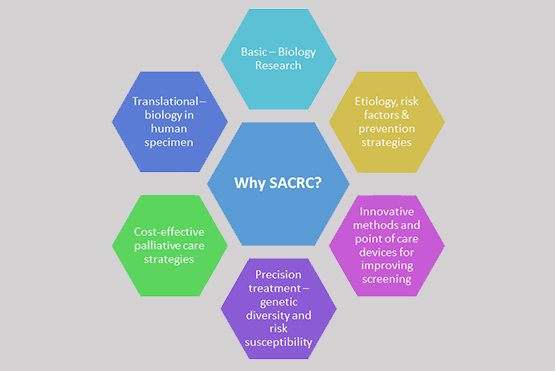
Incidence of different cancers vary from region to region in the country. SACRC will carry out cancer research on biology of population to help determine responsible risk factors and suggest strategies for prevention. Cost effective methods for improving screening will also be developed.
Focus on precision medicine research, will help in defining risks or susceptibility of certain population and requirement of dose modification or special precautions during the treatment. Currently, most of the patients report at advanced stages of the disease. Research efforts to develop cost-effective protocols for palliative care and other non-clinical areas will be helpful.
Key features
- State-of-the-art research hub to attract top talent globally for engaging in locally relevant oncology research and to generate evidence base for better control and management of cancers not only in Assam but also in neighboring states and countries
- Better genetic understanding of cancers specific to the region to result in early diagnosis, targeted therapies and development of refined treatment protocols
- To provide diploma/Ph.D./ Post-doctoral certificate courses for various domains of oncology research to educate clinicians for developing future researchers
- Comprehensive research system covering not only modern and traditional medicine, but also impact of various technologies and approaches on cancer care
- Covering all aspects of oncology research from prevention, awareness to bio-molecular to genetics, immunology to pharmacology to radio-biology