


Page 45 - Essentia Vol 5 Issue 1
P. 45
VOL V | ISSUE I | 5 AUGUST 2026  VOL V | ISSUE I | 5 AUGUST 2026
 A BIANNUAL NEWSLETTER OF ASSAM CANCER CARE FOUNDATION                                 A BIANNUAL NEWSLETTER OF ASSAM CANCER CARE FOUNDATION

             In comprehensive cancer care, physiotherapy has
             become  an  important  component  of  supportive
             oncology  and  rehabilitation.  Cancer  and  its
             treatments,  including  surgery,  chemotherapy,
             radiotherapy,  immunotherapy  and  hormonal
             therapy,  can  lead  to  fatigue,  pain,  muscle
             weakness,  reduced  mobility,  breathlessness,
             neuropathy,  lymphoedema,  postural  changes,
             urinary  problems,  deconditioning  and  reduced
             confidence  in  movement.  These  challenges  may
             arise during treatment and continue long after it is
             completed.
             The role of physiotherapy can begin at diagnosis.
             In  the  pre-treatment  phase,  prehabilitation  helps
             improve a patient’s physical reserve before surgery
             or  intensive  therapy.  Individualised  exercise,
             breathing  training,  mobility  work  and  patient
             education  may  improve  treatment  tolerance  and
             recovery, especially for patients already weakened
             by  disease,  anxiety,  poor  nutrition  or  reduced
             activity.
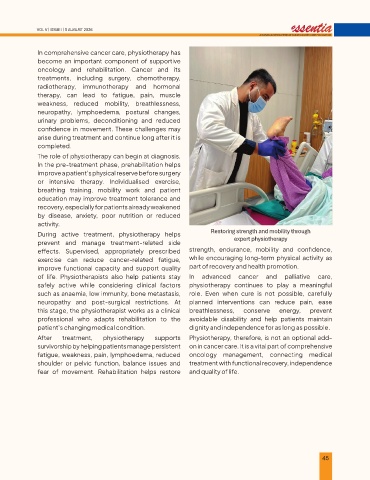
             During  active  treatment,  physiotherapy  helps          Restoring strength and mobility through
             prevent  and  manage  treatment-related  side                    expert physiotherapy
             effects.  Supervised,  appropriately  prescribed   strength,  endurance,  mobility  and  confidence,
             exercise  can  reduce  cancer-related  fatigue,    while  encouraging  long-term  physical  activity  as
             improve  functional  capacity  and  support  quality   part of recovery and health promotion.
             of  life.  Physiotherapists  also  help  patients  stay   In   advanced   cancer   and   palliative   care,
             safely  active  while  considering  clinical  factors   physiotherapy  continues  to  play  a  meaningful
             such as anaemia, low immunity, bone metastasis,    role.  Even  when  cure  is  not  possible,  carefully
             neuropathy  and  post-surgical  restrictions.  At   planned  interventions  can  reduce  pain,  ease
             this stage, the physiotherapist works as a clinical   breathlessness,   conserve   energy,   prevent
             professional  who  adapts  rehabilitation  to  the   avoidable  disability  and  help  patients  maintain
             patient’s changing medical condition.              dignity and independence for as long as possible.

             After    treatment,   physiotherapy    supports    Physiotherapy,  therefore,  is  not  an  optional  add-
             survivorship by helping patients manage persistent   on in cancer care. It is a vital part of comprehensive
             fatigue,  weakness,  pain,  lymphoedema,  reduced   oncology  management,  connecting  medical
             shoulder  or  pelvic  function,  balance  issues  and   treatment with functional recovery, independence
             fear  of  movement.  Rehabilitation  helps  restore   and quality of life.


 44                                                                                                         45

