


Page 85 - Essentia Vol 5 Issue 1
P. 85
VOL V | ISSUE I | 5 AUGUST 2026  VOL V | ISSUE I | 5 AUGUST 2026
 A BIANNUAL NEWSLETTER OF ASSAM CANCER CARE FOUNDATION                                 A BIANNUAL NEWSLETTER OF ASSAM CANCER CARE FOUNDATION

             and  previous  treatment,  radiation  protocols                    From Records
             reflect surgical and systemic therapy details, and                to Institutional
             follow-up imaging or biomarker assessments are
             interpreted in context.                                               Learning
             At  SCI  Guwahati,  the  MRD  supports  this
             coordination    through    a   daily   workflow.       Ê  Tracks case volumes, treatments and
             Appointment  files  for  upcoming  outpatient  visits   outcomes.
             are  retrieved  across  oncology  departments          Ê  Supports benchmarking and performance
             and  sent  to  the  respective  units  before  patient   reporting.
             consultations. This ensures that treating physicians     Ê  Enables academic research and
             have  updated  information  before  planning  or       publication.
             delivering  care,  improving  coordination  and
             reducing administrative delays.                        Ê  Informs planning, resource allocation and
                                                                    quality improvement.
              Maintaining cancer registries and
              treatment outcome tracking
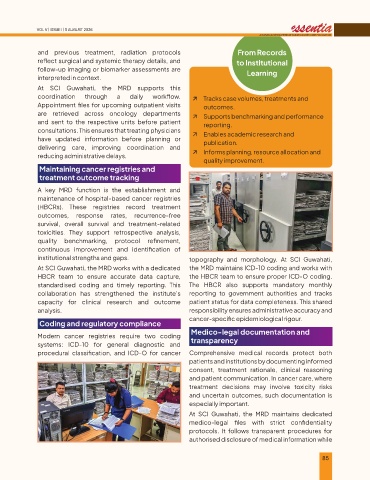
             A  key  MRD  function  is  the  establishment  and
             maintenance  of  hospital-based  cancer  registries
             (HBCRs).  These  registries  record  treatment
             outcomes,    response    rates,   recurrence-free
             survival,  overall  survival  and  treatment-related
             toxicities.  They  support  retrospective  analysis,
             quality   benchmarking,   protocol   refinement,
             continuous  improvement  and  identification  of
             institutional strengths and gaps.                  topography  and  morphology.  At  SCI  Guwahati,
             At SCI Guwahati, the MRD works with a dedicated    the MRD maintains ICD-10 coding and works with
             HBCR  team  to  ensure  accurate  data  capture,   the  HBCR  team  to  ensure  proper  ICD-O  coding.
             standardised  coding  and  timely  reporting.  This   The  HBCR  also  supports  mandatory  monthly
             collaboration  has  strengthened  the  institute’s   reporting  to  government  authorities  and  tracks
             capacity  for  clinical  research  and  outcome    patient status for data completeness. This shared
             analysis.                                          responsibility ensures administrative accuracy and
                                                                cancer-specific epidemiological rigour.
              Coding and regulatory compliance
             Modern  cancer  registries  require  two  coding   Medico-legal documentation and
             systems:  ICD-10  for  general  diagnostic  and    transparency
             procedural  classification,  and  ICD-O  for  cancer   Comprehensive  medical  records  protect  both
                                                                patients and institutions by documenting informed
                                                                consent,  treatment  rationale,  clinical  reasoning
                                                                and patient communication. In cancer care, where
                                                                treatment  decisions  may  involve  toxicity  risks
                                                                and  uncertain  outcomes,  such  documentation  is
                                                                especially important.
                                                                At  SCI  Guwahati,  the  MRD  maintains  dedicated
                                                                medico-legal  files  with  strict  confidentiality
                                                                protocols.  It  follows  transparent  procedures  for
                                                                authorised disclosure of medical information while


 84                                                                                                         85

