


Page 19 - Essentia Vol 5 Issue 1
P. 19
VOL V | ISSUE I | 5 AUGUST 2026  VOL V | ISSUE I | 5 AUGUST 2026
 A BIANNUAL NEWSLETTER OF ASSAM CANCER CARE FOUNDATION                                 A BIANNUAL NEWSLETTER OF ASSAM CANCER CARE FOUNDATION
                                                                 Stereotactic


                                                            Radiosurgery


                                       Dr Thamizholi Selvaraju                            (SRS)
                                       Senior Consultant
                                       Radiation Oncologist
                                       Barpeta Cancer Centre


              Introduction                                         intersection  (the  isocentre),  the  cumulative
                                                                   energy delivers a lethal dose to the target.
                   tereotactic  Radiosurgery  (SRS)  is  a  highly
                   precise,  non-invasive  form  of  radiation     Ê  Biological  Effect:  High-intensity  radiation
             Stherapy  used  for  selected  tumours  and           breaks the double-stranded DNA of targeted
             functional  abnormalities  of  the  brain  and  spine.   cells,  preventing  replication  and  causing  the
                                                                   lesion to shrink or stabilise over time.
             Despite the term “surgery”, it involves no incision,
             scalpel  or  general  anaesthesia.  Using  advanced   Primary delivery platforms
             3D  neuroimaging,  SRS  delivers  a  high-intensity
             dose  of  focused  radiation  to  a  defined  lesion   Three  main  technological  systems  are  used  to
             while minimising exposure to surrounding healthy   administer SRS:
             structures.                                        1.  Gamma     Knife:   Uses   fixed   cobalt-60
                                                                   radioactive  sources.  It  is  highly  specialised

              Core mechanism of action                             for  small-to-medium  intracranial  targets  and
                                                                   usually requires a rigid, pin-based head frame.
             Unlike conventional fractionated radiation therapy,
             which  delivers  smaller  doses  over  several  weeks,   2.  Linear  Accelerator  (LINAC):  Generates  high-
                                                                   energy  X-rays.  Systems  such  as  Varian  True
             SRS achieves an “ablative” effect in 1–5 sessions.    Beam  or  Cyber  Knife  use  robotic  arms  and
                 Ê  Spatial  Convergence:  Dozens  of  low-dose    real-time image guidance, allowing frameless
                 radiation  beams  are  directed  from  multiple   treatment.
                 angles toward a single 3D coordinate point.    3.  Proton Beam Therapy: Uses charged particles

                 Ê  Summation  Effect:  Each  individual  beam     instead of photons. Protons exhibit the “Bragg
                 passes  safely  through  healthy  tissue  with    Peak”,  with  energy  falling  off  immediately
                 minimal  damage.  At  the  exact  point  of       after reaching the target depth.

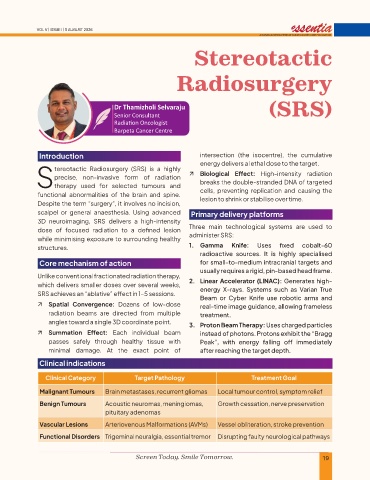
              Clinical indications

                Clinical Category             Target Pathology                      Treatment Goal

              Malignant Tumours     Brain metastases, recurrent gliomas  Local tumour control, symptom relief

              Benign Tumours        Acoustic neuromas, meningiomas,      Growth cessation, nerve preservation
                                    pituitary adenomas

              Vascular Lesions      Arteriovenous Malformations (AVMs)   Vessel obliteration, stroke prevention
              Functional Disorders Trigeminal neuralgia, essential tremor  Disrupting faulty neurological pathways


 18                                           Screen Today. Smile Tomorrow.                                 19

