


Page 23 - Essentia Vol 5 Issue 1
P. 23
VOL V | ISSUE I | 5 AUGUST 2026  VOL V | ISSUE I | 5 AUGUST 2026
 A BIANNUAL NEWSLETTER OF ASSAM CANCER CARE FOUNDATION                                 A BIANNUAL NEWSLETTER OF ASSAM CANCER CARE FOUNDATION
              Climate Change


              and Health


              An Emerging Crisis for India and the North-East


                                                                                  Lt Col (Dr) Pranab Bhuyan
                                                                                  Assistant Medical Superintendent
                                                                                  State Cancer Institute, Guwahati


                    limate  change  has  evolved  from  an      Heatwaves  are  also  becoming  more  humid,
                    environmental  concern  into  one  of  the   reducing the body’s ability to cool itself and further
             Cgreatest  public  health  challenges  of  the     increasing health risks.
             twenty-first century. The World Health Organization   The   North-Eastern   region   faces   unique
             identifies  it  as  the  single  largest  threat  to  human   vulnerabilities  due  to  its  fragile  ecosystems,  hilly
             health, with rising temperatures, extreme weather   terrain  and  climatic  sensitivity.  Erratic  rainfall,
             events,  changing  rainfall  patterns,  worsening  air   recurrent  floods,  landslides  and  environmental
             quality  and  ecological  disruption  increasingly   degradation  increasingly  disrupt  access  to
             influencing  disease  patterns,  healthcare  delivery   healthcare,  safe  water,  sanitation  and  food
             and  population  health.  India,  with  its  vast   supplies.  Flooding  in  the  Brahmaputra  and
             population, climatic diversity and socioeconomic   Barak  river  basins  contributes  to  higher  rates  of
             vulnerabilities,  is  among  the  countries  most
             exposed to these impacts.
             According  to  projections  by  the  Ministry  of
             Earth  Sciences,  India  is  expected  to  experience
             rising  temperatures  alongside  more  frequent
             heatwaves,  floods,  droughts,  cyclones  and
             extreme  precipitation  events.  These  changes  are
             already  affecting  millions  and  placing  increasing
             pressure  on  healthcare  systems.  Nearly  57%  of
             Indian districts, home to over three-fourths of the
             population, face high or very high risk from extreme
             heat.
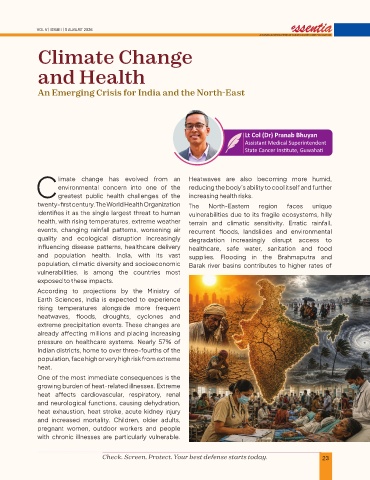
             One of the most immediate consequences is the
             growing burden of heat-related illnesses. Extreme
             heat  affects  cardiovascular,  respiratory,  renal
             and  neurological  functions,  causing  dehydration,
             heat  exhaustion,  heat  stroke,  acute  kidney  injury
             and  increased  mortality.  Children,  older  adults,
             pregnant  women,  outdoor  workers  and  people
             with  chronic  illnesses  are  particularly  vulnerable.


 22                                Check. Screen. Protect. Your best defense starts today.                  23

