


Page 26 - Essentia Vol 5 Issue 1
P. 26
VOL V | ISSUE I | 5 AUGUST 2026            VOL V | ISSUE I | 5 AUGUST 2026
              A BIANNUAL NEWSLETTER OF ASSAM CANCER CARE FOUNDATION                                                                                                                                              A BIANNUAL NEWSLETTER OF ASSAM CANCER CARE FOUNDATION

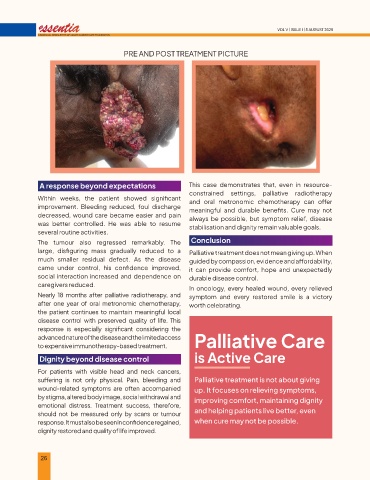
                                          PRE AND POST TREATMENT PICTURE


              A response beyond expectations                    This  case  demonstrates  that,  even  in  resource-
                                                                constrained  settings,  palliative  radiotherapy
              Within  weeks,  the  patient  showed  significant   and  oral  metronomic  chemotherapy  can  offer
              improvement.  Bleeding  reduced,  foul  discharge   meaningful  and  durable  benefits.  Cure  may  not
              decreased,  wound  care  became  easier  and  pain   always  be  possible,  but  symptom  relief,  disease
              was  better  controlled.  He  was  able  to  resume   stabilisation and dignity remain valuable goals.
              several routine activities.
              The  tumour  also  regressed  remarkably.  The    Conclusion
              large,  disfiguring  mass  gradually  reduced  to  a   Palliative treatment does not mean giving up. When
              much  smaller  residual  defect.  As  the  disease   guided by compassion, evidence and affordability,
              came  under  control,  his  confidence  improved,   it  can  provide  comfort,  hope  and  unexpectedly
              social  interaction  increased  and  dependence  on   durable disease control.
              caregivers reduced.                               In  oncology,  every  healed  wound,  every  relieved
              Nearly  18  months  after  palliative  radiotherapy,  and   symptom  and  every  restored  smile  is  a  victory
              after  one  year  of  oral  metronomic  chemotherapy,   worth celebrating.
              the  patient  continues  to  maintain  meaningful  local
              disease  control  with  preserved  quality  of  life.  This
              response  is  especially  significant  considering  the
              advanced nature of the disease and the limited access
              to expensive immunotherapy-based treatment.        Palliative Care

              Dignity beyond disease control                     is Active Care

              For  patients  with  visible  head  and  neck  cancers,
              suffering  is  not  only  physical.  Pain,  bleeding  and   Palliative treatment is not about giving
              wound-related  symptoms  are  often  accompanied   up. It focuses on relieving symptoms,
              by stigma, altered body image, social withdrawal and   improving comfort, maintaining dignity
              emotional  distress.  Treatment  success,  therefore,
              should  not  be  measured  only  by  scans  or  tumour   and helping patients live better, even
              response. It must also be seen in confidence regained,   when cure may not be possible.
              dignity restored and quality of life improved.


              26                                                                                                                                                                                                                      27

